

Mathematically, the universe can be infinite. It can also be finite. But what separates them? If the universe is finite, does that mean it ends somewhere? Is there a wall?
The word gets in the way
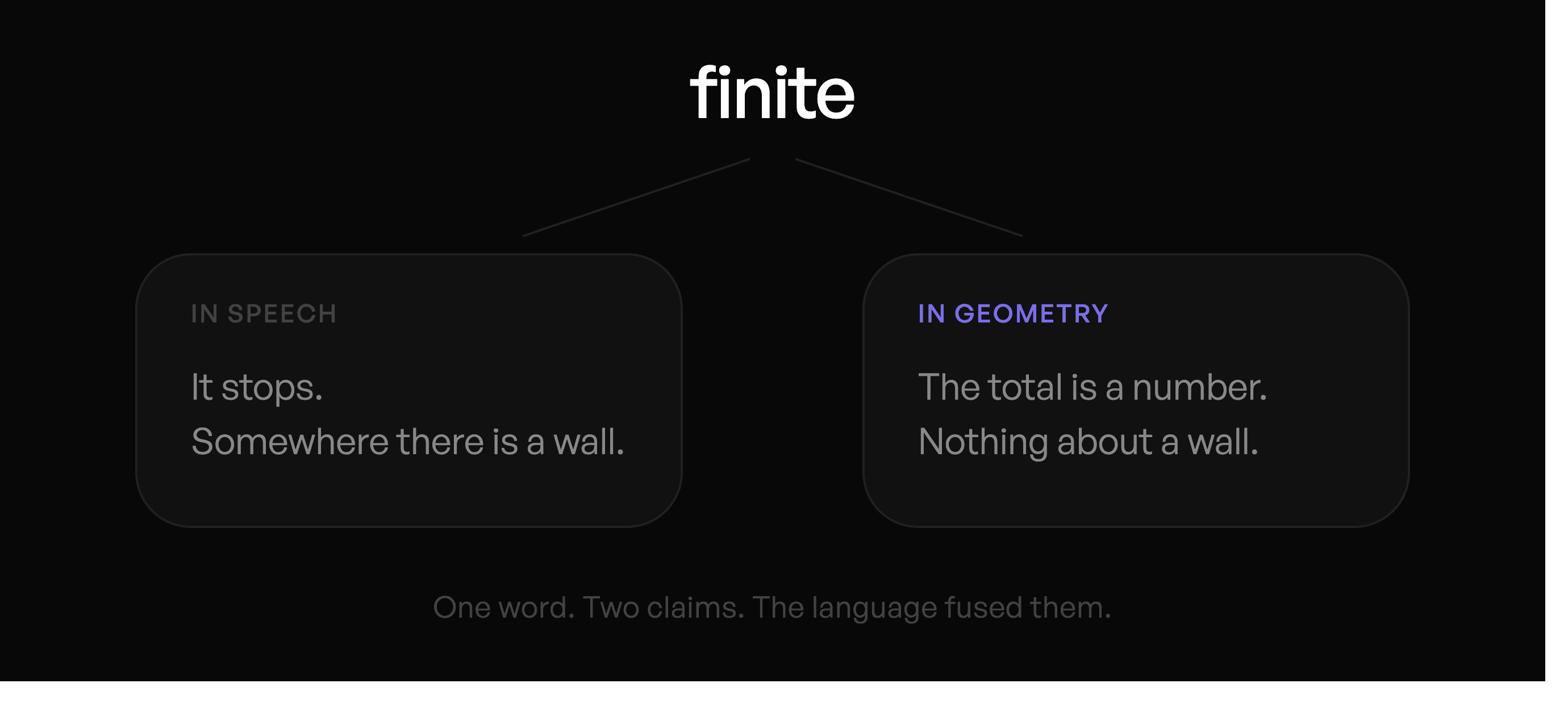
Finite, in everyday speech, means it stops. Somewhere out there, a last thing.
In geometry it means the total is a number.
Every space a person has ever stood inside had a boundary. The room. The valley. The horizon. The atmosphere. We built the word to fit the scale we live at and inside that scale it never failed us once.
But a finite universe has no wall in it. No border, no final point, nowhere that anything stops.
So if there is no boundary, what makes it different from an infinite one?
It comes down to shape.
Three shapes
The shape of the universe reduces to one number.
Physicists call it Ω_k. It tells you how light behaves as it moves through space.
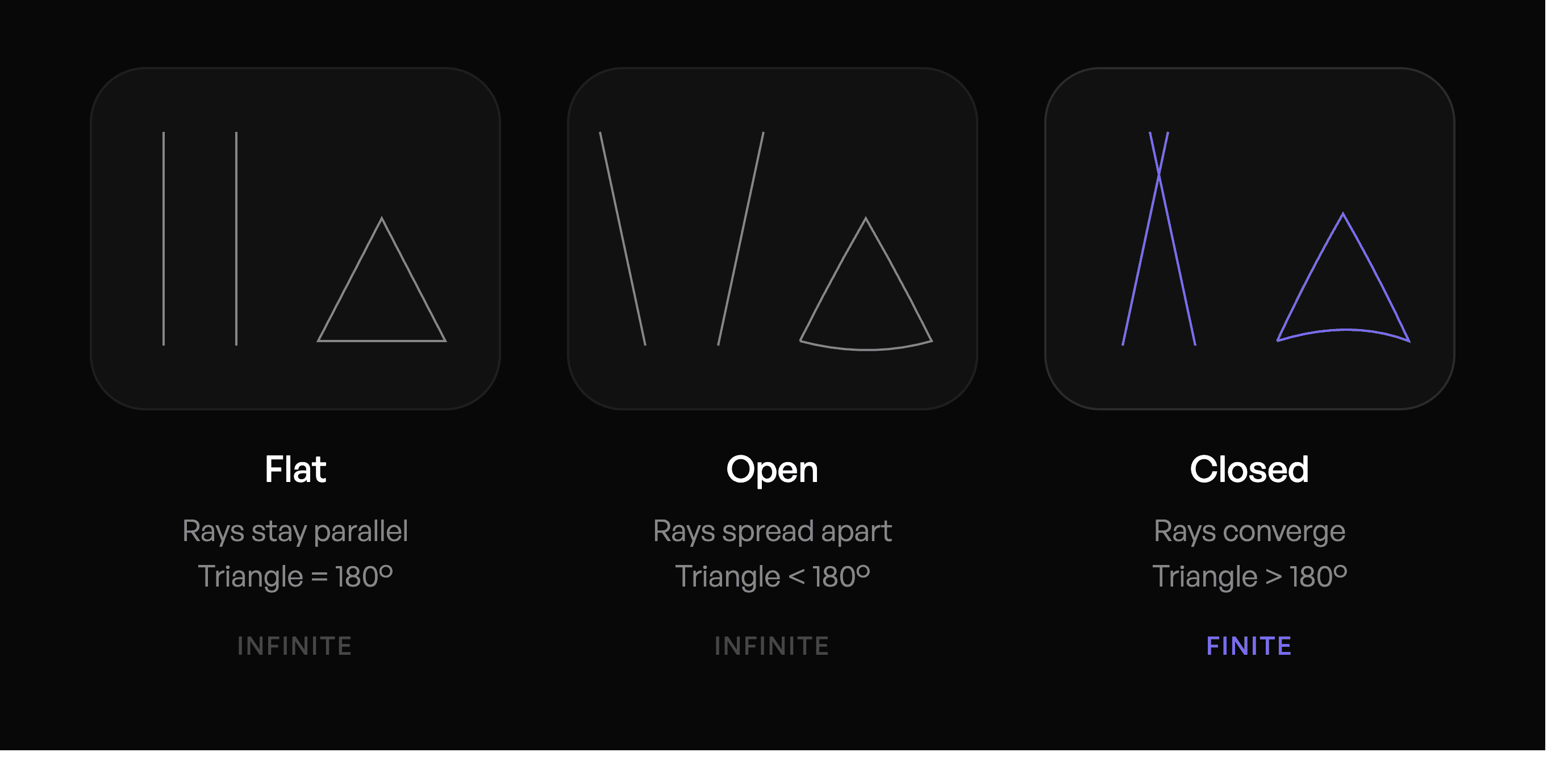
Flat. Two parallel beams stay parallel forever. A triangle adds up to a hundred and eighty degrees, whether you draw it on a table or across a billion light years. This universe is infinite.
Open. The beams spread apart. Space opens under them faster than they travel. A triangle comes in under a hundred and eighty. Infinite as well.
Closed. The beams converge. A triangle comes in over a hundred and eighty. A beam travelling perfectly straight eventually arrives back where it started. This universe is finite.
Three geometries. None of them has an edge.
How something finite has no edge
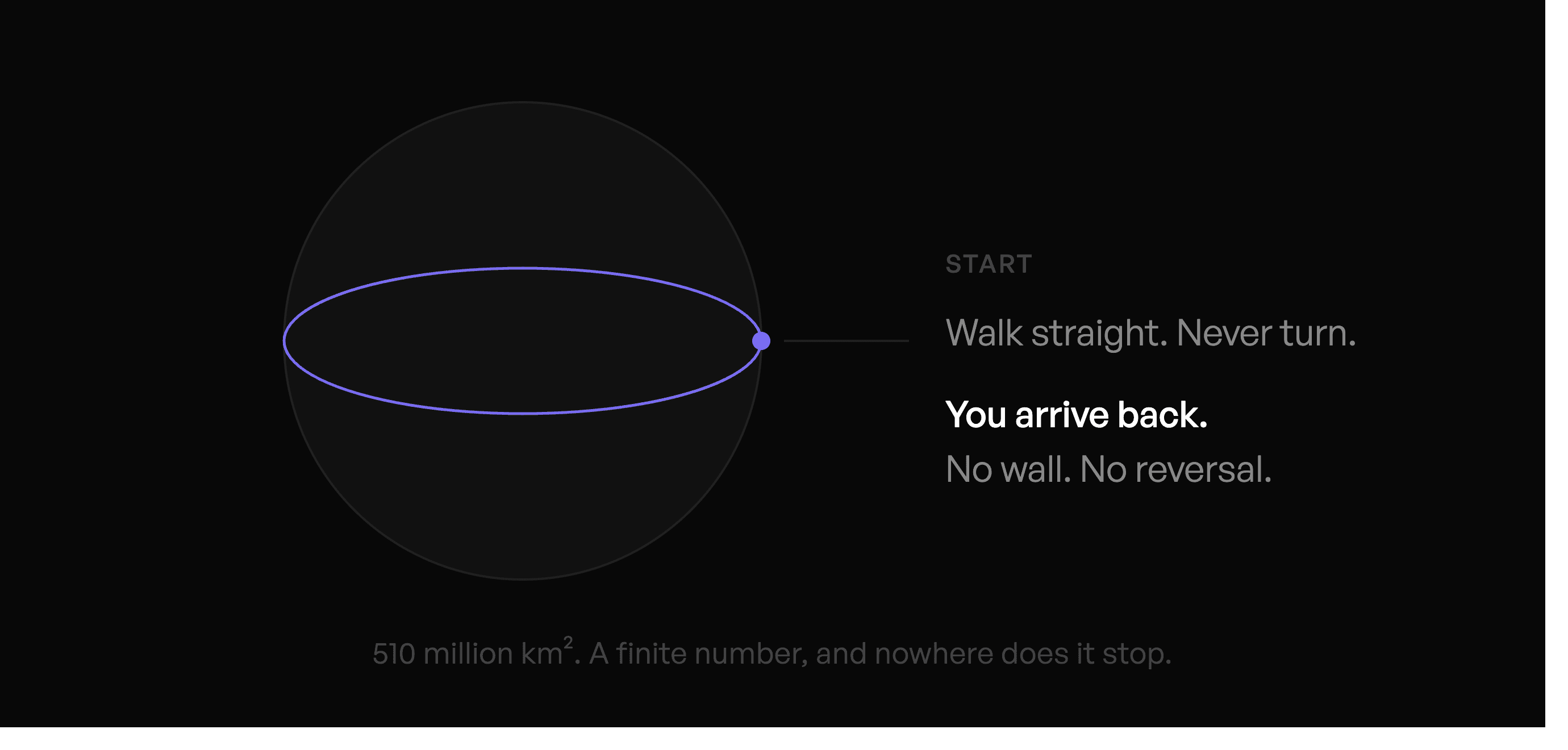
Take the surface of the Earth. Five hundred and ten million square kilometres. A finite number, you can write it down.
Walk straight, never turn, and you come home without ever having reversed.
A closed universe works the same way, one dimension up. Not a sphere. A three dimensional surface that closes back on itself.
We cannot see it. Our vision works in three dimensions, and to look at that shape from the outside you would need four. We will never draw it and we will never picture it.
But we can calculate it. The equations hold. Light behaves predictably. We can say what a beam will be doing ten billion years from now while having no way at all to imagine it.
We calculate what we cannot picture. That might be the strangest thing our species knows how to do.
What the question actually is
When we ask whether the universe is finite, we are not asking about a wall.
We are asking how much there is.
Finite means there is a limit. A specific number of atoms. A specific volume.
Infinite means there is no limit. And then, somewhere far enough out, there is a region indistinguishable from this one. Same planet. Same person, reading the same text.
So which is it
Nobody knows. The measurements point in different directions.
I would bet on finite. Not because the data shows it. It doesn't.
Infinity in physics has almost always been a sign we misunderstood something.
Infinite density in a black hole.
Infinities in particle calculations Dirac never accepted as honest math. Every time, it marked where the theory ran out.
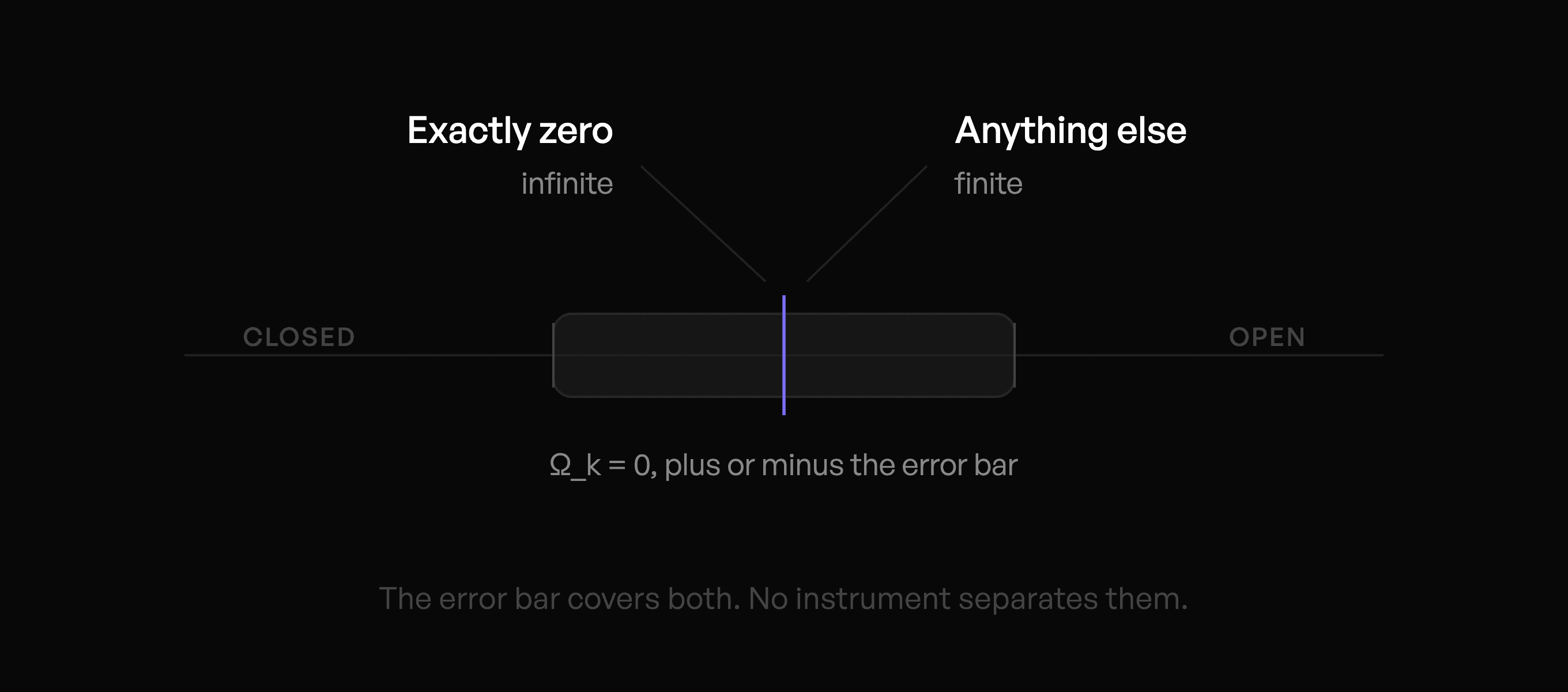
And this one cannot be checked. Instruments give Ω_k = 0, plus or minus an error bar. Between exactly zero and almost zero sits the difference between infinite and finite. No instrument will ever separate them.
So the choice doesn't get made in the data.
Infinite means infinite matter. Infinite stars. Infinite copies of this room and this text. Finite asks for none of that.
There is an end. We are standing too close to the beginning to see it.
