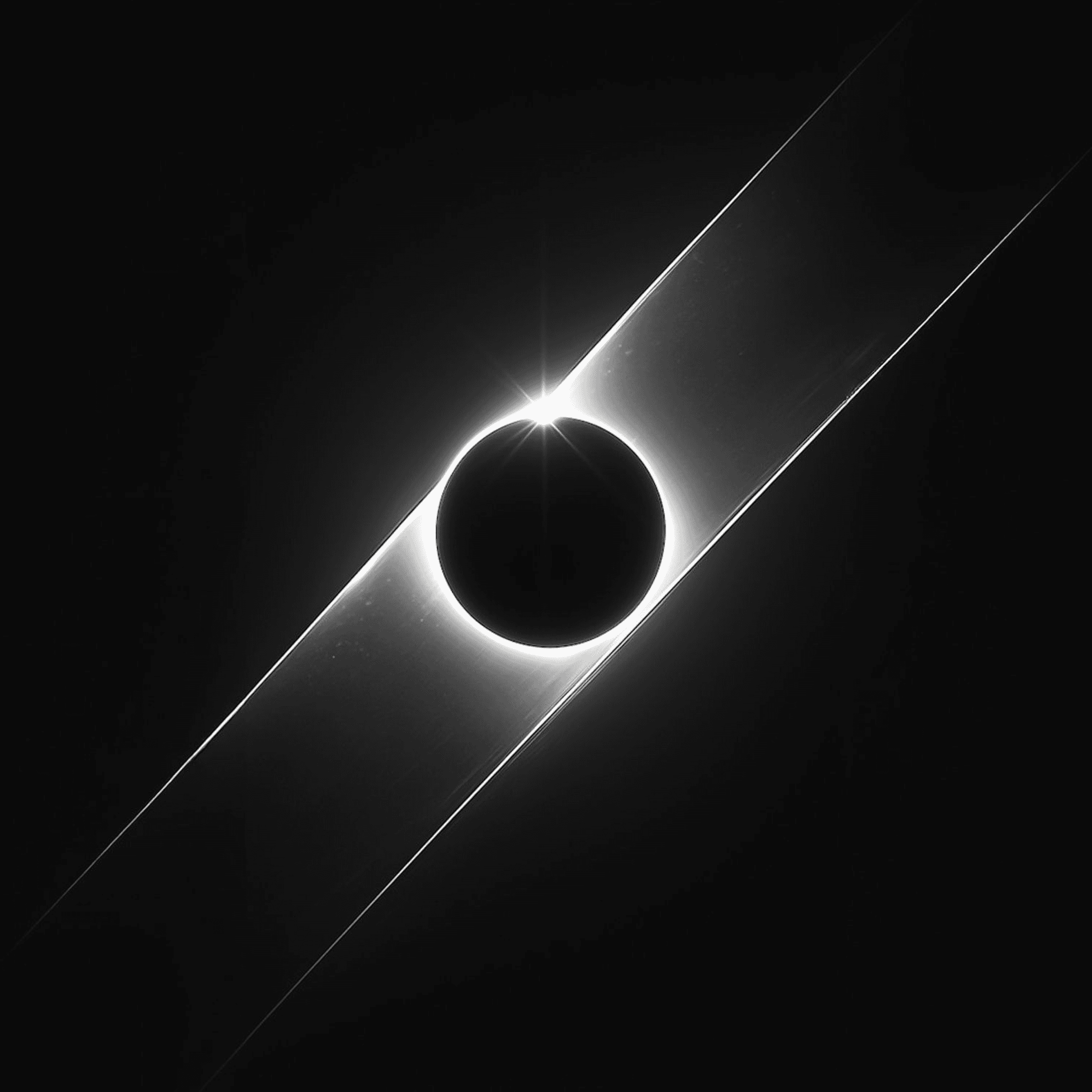

The most powerful force in the universe makes no sound, asks for nothing, and never explains itself. It doesn’t compete. It doesn’t convince. It just pulls.
Before We Talk About Design
Somewhere at the center of our galaxy (about 26,000 light-years from Earth) there is an object called Sagittarius A*.
Its mass is four million suns.
It doesn't glow. You can't see it directly. But everything around it — every star, every cloud of gas, the entire galactic arm moves around it. Slowly, inevitably, without question.
This is a black hole. And it never asked for anyone's attention.
"The cosmos is under no obligation to make sense to us." — Carl Sagan, Pale Blue Dot, 1994
What Is a Black Hole, Actually
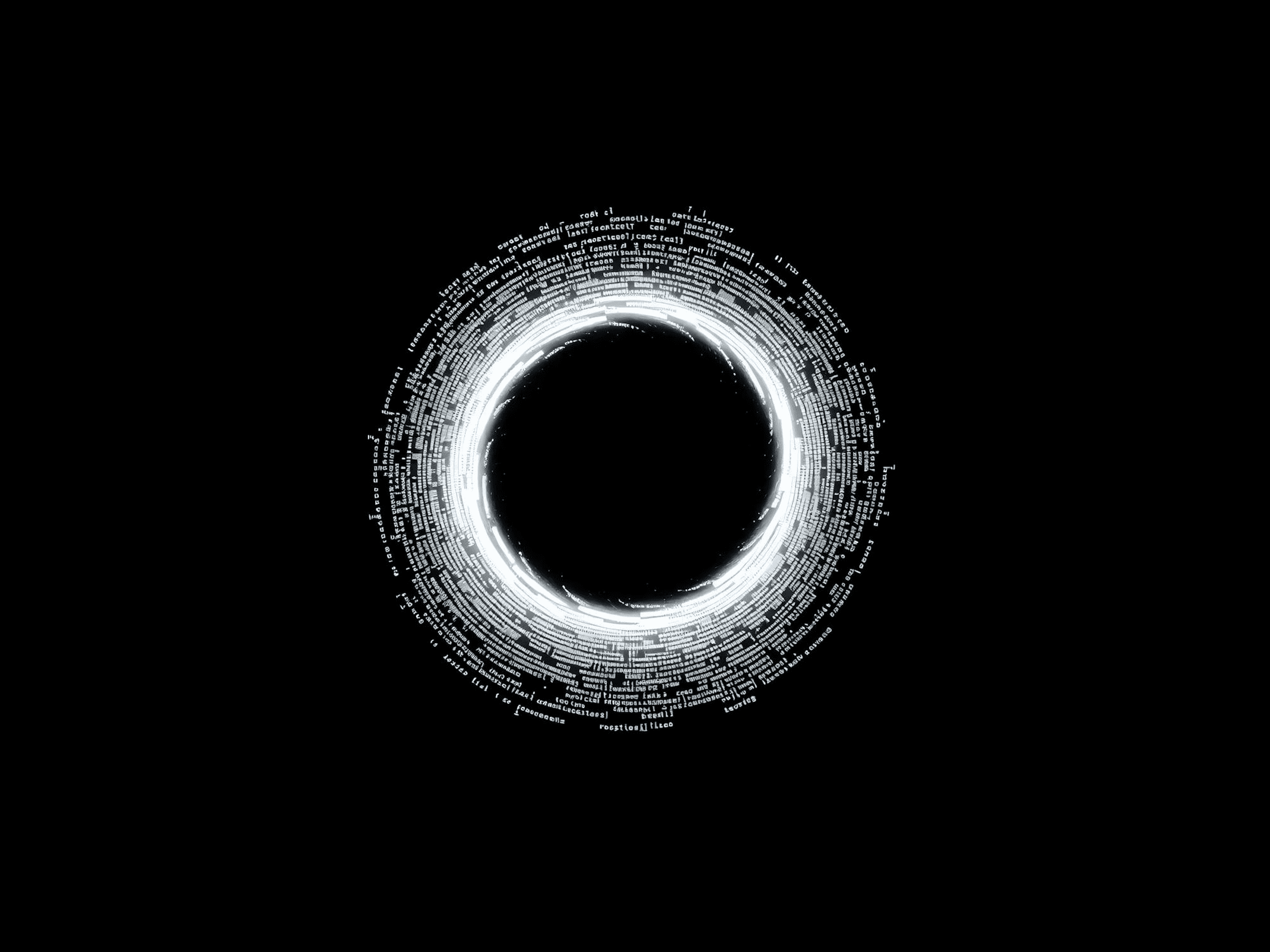
A black hole is not a hole and not an emptiness. It is an object with such enormous mass that gravity around it warps space-time itself. Enough to prevent even light - the fastest thing in the universe from escaping.
In 1916, Karl Schwarzschild, solving Einstein's equations on the front lines of World War I, described the mathematical boundary around such an object. It would later be called the event horizon.
The event horizon is not a wall. It is a boundary. Before it, you can still turn around and leave. After it, physics no longer allows that. Not because something is holding you. Simply because all paths lead only inward.
A black hole doesn't persuade. It just creates conditions where leaving becomes impossible.
Attention Works the Same Way
We are used to thinking of attention as a resource. Something finite that needs to be "captured", "retained", "converted".
But that's an inaccurate model.
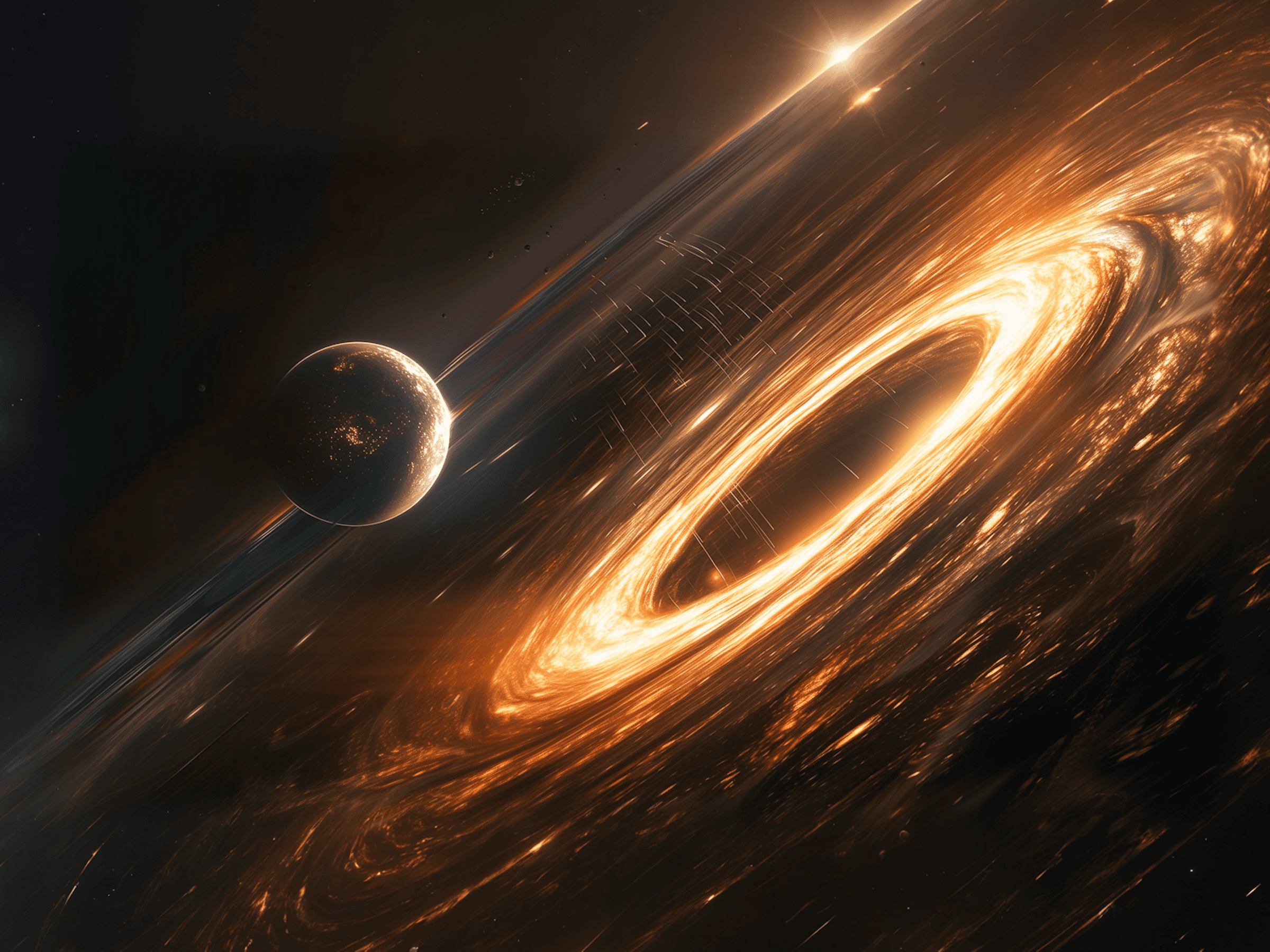
Attention works like gravity. It isn't captured - it's attracted. And it's attracted not by effort, not by volume, not by the number of touchpoints. It's attracted by mass.
Physicists tell us: the greater the mass of an object, the more it curves the space around it. Matter doesn't "decide" to move toward a black hole. It simply follows the curvature of space. The path of least resistance leads there.
A strong product works the same way. The user doesn’t decide to stay. By the time they notice, the decision is already behind them.
"We are all connected to the universe — not metaphorically, but literally. The atoms in our bodies were once inside stars." — Neil deGrasse Tyson
Mass Is Not Features
This is where a founder usually thinks: "so I need more features, more content, more pages".
No. That's the mistake.
Mass in physics is not volume. A neutron star is smaller than a city but heavier than the Sun. Density matters more than size.
Mass in a product is density of meaning. One screen that says something real and precise weighs more than twenty slides full of bullet points. One headline that hits exactly on the pain - creates more gravity than a forty-item FAQ.
Most products are large objects with very little mass. Lots of space, almost no pull. The user comes in, moves through the pages, and leaves. Not because something was wrong. Just nothing to hold onto. No curvature.
The Event Horizon of a Product
In every good product there is a moment (one specific moment) after which the user stops comparing you to competitors. They simply stay.
It's not the onboarding. Not the paywall. Not the email with a promo code.
It's the moment when something clicks at the level of feeling. Not logic. Not analysis. Just yes, this is it.
That is the event horizon of a product.
This is what the best designers in the world are searching for.
Before this moment the user still hesitates, compares, doubts. After no. The boundary has been crossed. Not because you convinced them. Because you created enough mass for the curvature to bring them there on its own.
Most products never create this moment. They keep the user near the horizon but never past it. Constantly explaining, proving, persuading.
A black hole doesn't persuade.
Black Holes Don't Explain Themselves
This is, perhaps, the most important part.
A black hole doesn't write on its landing page "we are the most powerful gravitational object in the universe". Its nature is visible through how everything around it behaves. Stars accelerate. Light bends. Time slows down.
In 2019, scientists photographed a black hole for the first time - M87*, at a distance of 55 million light-years. The image doesn't show the hole itself. It shows what is happening around it. Superheated gas twisted into a ring. A shadow at the center. Its presence is read through the behavior of everything nearby.
A strong product works the same way. Its quality is not written on the About page. It is felt through how the animation works on load. Through how the typography looks. Through how the first screen is written. Through the pause in the right place.
"The beauty of a scientific fact is that it doesn't need our approval." — Carl Sagan
For Founders
Most founders build products as if the user will read. Study. Weigh the arguments.
But the user doesn't read. They fall.
Like matter near a black hole, they move along the curvature of the space you created. Either that curvature leads them toward you. Or toward someone else.
Design is not a layer on top of the product. Design is mass. It is what creates the curvature. It is what decides which direction the user falls when they land on your site in the first eight seconds.
Stop building features. Start building gravity.
Because every product either bends reality around itself or disappears inside someone else’s.
There is no middle ground.